For veteran-owned businesses pursuing corporate opportunities, a capability statement can be one of the most important tools in the business development process. But a capability statement designed for government contracting may not be the document that gets the attention of a corporate buyer.
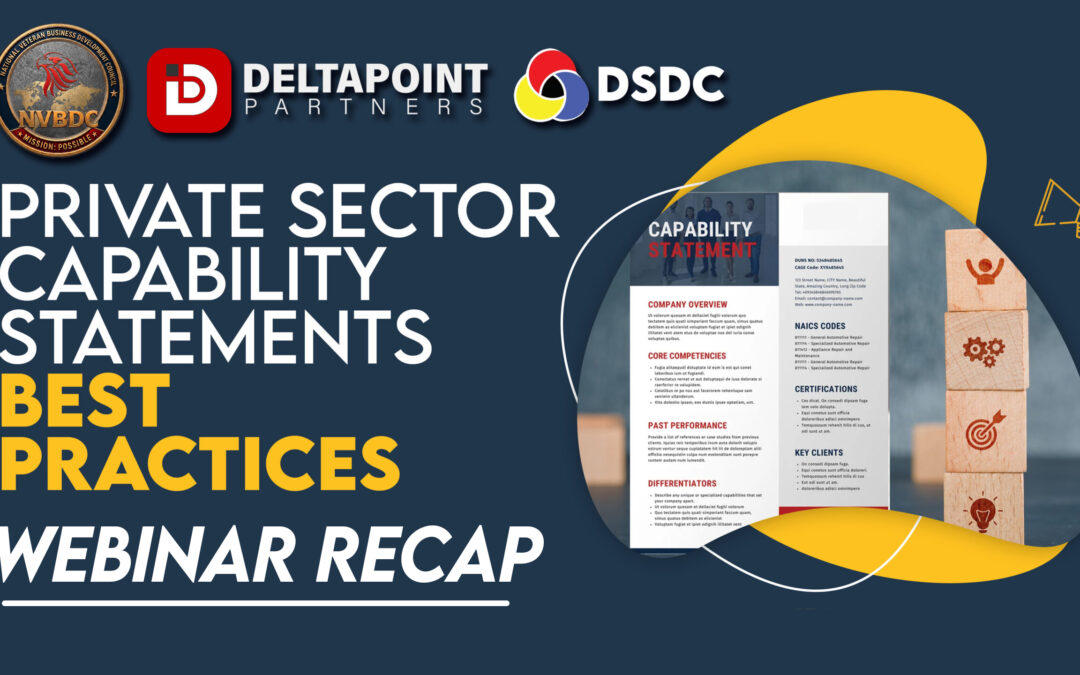
That was one of the central messages from NVBDC’s Private Sector Capability Statements: Best Practices webinar, held August 13, 2026.
The session focused on helping veteran business owners rethink the traditional capability statement—not simply as a document listing services, certifications, and industry codes, but as a strategic marketing tool designed to quickly communicate value, establish credibility, and create a reason for a buyer to continue the conversation.
Your Capability Statement Has One Job: Create Interest
A capability statement is often described as a company’s resume. That comparison is useful, but in the private sector, it should also be viewed as a marketing piece.
Corporate procurement and supplier diversity professionals may review numerous potential suppliers. Your document needs to quickly answer several basic questions:
What does your company do? What problem can you solve? Why should we consider you?
The first 30 seconds matter.
Long company histories and paragraphs filled with technical language can make it difficult for a buyer to identify the information that matters most. Strong capability statements use concise language, short phrases, bullet points, clear headings, and thoughtful design to make the company’s value immediately understandable.
Government and Private Sector Capability Statements Are Different
Businesses accustomed to government contracting often develop capability statements around government procurement conventions. That can include NAICS codes, contract vehicles, extensive certification information, and terminology familiar to government contracting officers.
Those elements can still be valuable, but corporate procurement is different.
Private sector capability statements allow businesses greater flexibility in presentation, branding, messaging, and even length. A professionally designed two-page document may be more effective than attempting to force everything onto a single page.
More importantly, the language should speak to the corporation rather than simply describing the supplier.
Instead of asking, “What information do we want to tell them about our company?” businesses should begin by asking, “What does this buyer need from a company like ours?”
That shift can completely change the effectiveness of the document.
One Capability Statement Shouldn’t Be Sent Everywhere
One of the strongest takeaways from the webinar was the importance of customization.
The same capability statement should not necessarily be sent to every corporation.
Before approaching a potential customer, research the organization, its industry, procurement priorities, supplier requirements, and potential needs. Then determine which of your capabilities, products, services, experience, and results are most relevant.
A construction company approaching an automotive manufacturer may need to emphasize different experience than it would when approaching a healthcare system. A technology provider pursuing a financial institution may need different messaging than when approaching a retailer.
The company hasn’t changed. The story being told has.
Businesses should also understand the keywords, terminology, and industry codes corporate procurement teams may use when searching supplier portals. Using the right language can make it easier for procurement professionals to understand—and potentially discover—your company.
Move From “What We Do” to “What We Solve”
Many capability statements read like service catalogs.
We provide this.
We manufacture that.
We offer these services.
That information is necessary, but it isn’t always persuasive.
Corporate buyers are ultimately looking for solutions.
A stronger capability statement connects a company’s capabilities to business outcomes. What problems do you solve? What risks do you reduce? What efficiencies do you create? What makes your company easier, faster, safer, more reliable, or more effective to work with?
This is where a strong Unique Selling Proposition (USP) becomes critical.
Developing that proposition requires understanding the customer’s needs, pain points, expectations, and motivations—and then identifying the specific qualities that distinguish your company from competitors.
The goal isn’t simply to say you’re different.
Show why that difference matters to the customer.
Past Performance Should Demonstrate What You’re Capable Of
Past performance remains one of the strongest ways to establish credibility.
But businesses should be selective.
Rather than listing every customer or contract, highlight experience that demonstrates the scope, scale, complexity, or results most relevant to the opportunity being pursued.
Government contractors can also translate government experience for corporate audiences. A large federal contract may demonstrate the ability to manage complex logistics, strict compliance requirements, large geographic footprints, aggressive timelines, or significant volumes.
Those capabilities can be highly relevant to a corporation even if the original customer was a government agency.
The key is providing context so a corporate buyer understands why that experience matters to them.
Make Veteran-Owned Certification Part of the Value Proposition
Veteran-owned certification can be an important differentiator, particularly for corporations committed to expanding opportunities for veteran-owned suppliers.
But certification should complement the business case—not replace it.
Businesses should lead with their ability to deliver.
The experience developed through military service can also be meaningful when connected authentically to business performance. Leadership, discipline, adaptability, accountability, problem-solving, and mission focus can help differentiate a veteran-owned company when those qualities are demonstrated through how the business operates and serves its customers.
The strongest message isn’t simply, “We are veteran-owned.”
It is: “Here is the value we deliver, here is what makes us different, and veteran leadership is part of how we deliver it.”
Design Matters
A capability statement may contain excellent information and still fail to make an impact if it is difficult to read.
Private sector capability statements provide an opportunity to use professional branding, relevant imagery, creative layouts, strong typography, and sufficient white space.
The document should be easy to scan.
Core competencies, differentiators, relevant past performance, certifications, company information, industry codes, and contact information should be clearly organized and easy to locate.
And don’t overlook the basics.
Contact information must be current and professional. When a procurement professional reaches out, businesses need to be prepared to respond quickly. Creating interest is only valuable if the company is ready for the conversation that follows.
The Capability Statement Opens the Door—Relationships Create Opportunities
Perhaps the most important lesson extends beyond the document itself.
A capability statement is not the sale.
It is the beginning of a conversation.
When a corporate buyer or supplier diversity professional expresses interest, the next step shouldn’t always be an immediate sales pitch. Ask questions. Learn about the organization. Understand its challenges, priorities, procurement processes, and current needs.
Successful supplier relationships are built by understanding where your company can genuinely provide value.
That requires listening as much as selling.
Your Capability Statement Is Never Really Finished
Businesses change. Customers change. Capabilities expand. New projects create stronger past performance. Industries evolve, and new opportunities emerge.
Your capability statement should evolve with them.
Treat it as a living business development tool rather than a document that gets created once and stored on a computer.
Review it regularly. Update your accomplishments. Refine your differentiators. Adjust your messaging. Most importantly, customize it for the customer you are trying to reach.
The question isn’t simply whether you have a capability statement.
The better question is:
Does your capability statement give the buyer a compelling reason to have the next conversation?
That is where opportunity begins.